

Insurance Carriers Decide What Your Firm Is Worth Before They Read Your Demand

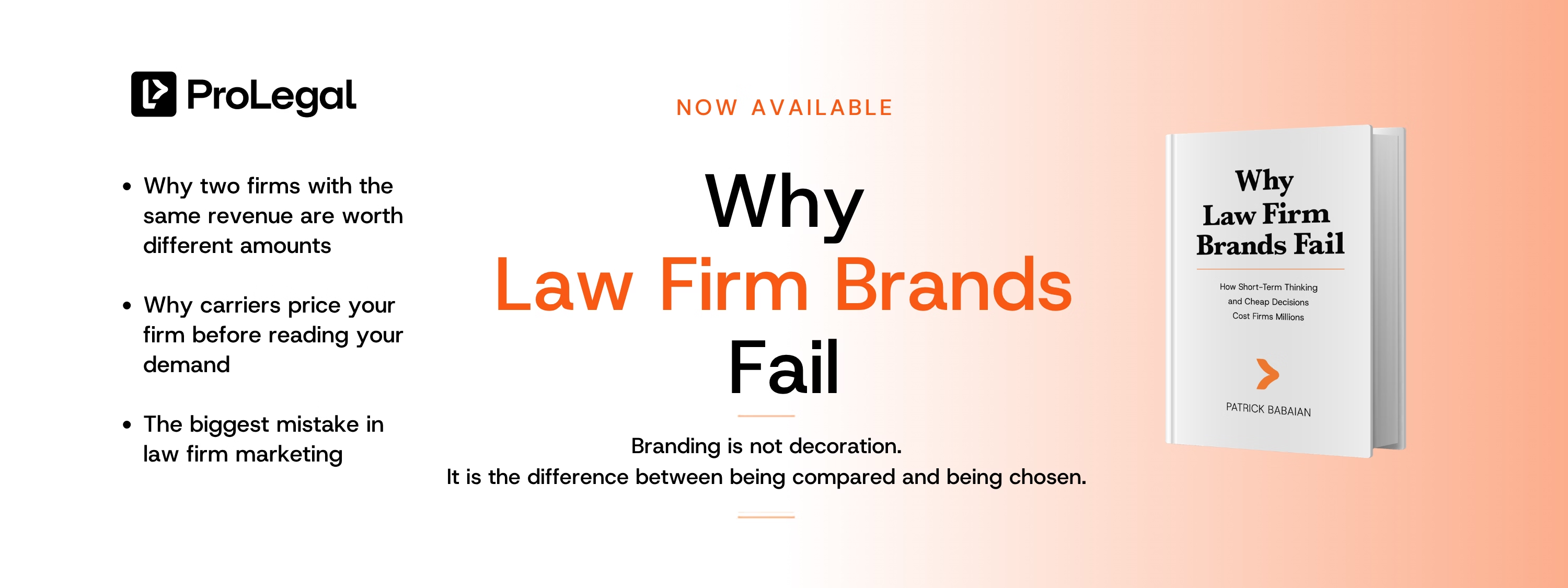
Most law firms believe they have a marketing problem. ProLegal CEO Patrick Babaian believes they have something far more expensive, and far harder to see.
His new book, Why Law Firm Brands Fail, released this week, makes an argument that will be uncomfortable for a lot of firm owners. It is that the legal market makes its most consequential decisions about a firm long before anyone reviews its results. Clients decide who feels trustworthy before they understand credentials. Referral partners decide who feels safe to recommend before they ask a single question. And carriers decide who feels costly to fight before the first demand letter is ever opened.
"Insurance carriers decide who feels costly to fight before they ever read your demand," said Patrick Babaian, CEO and Founder of ProLegal. "Referral partners decide who feels safe to recommend before they ask a single question. Those judgments are not made maliciously, they are made instinctively, and they are made long before anyone looks at your results."
That reframing is the spine of the book. Branding, in Babaian's telling, is not a logo, a color palette, or a website refresh scheduled every few years when the current one starts to feel dated. It is the infrastructure of trust, and it is priced into outcomes whether a firm manages it deliberately or not.
The Damage Is Real, and It Is Silent
The book spends considerable time on why so few firms catch the problem in time. The answer is that brand failure does not announce itself.
"The most dangerous branding failures are quiet," Babaian said. "Nothing breaks. The phones still ring, the cases still come in, and the firm assumes the market is just competitive. What it does not see is the case that never called, the referral that went elsewhere, and the associate who chose another firm without ever applying."
Because those losses are invisible, they get rationalized. Firms blame advertising costs, market saturation, or a bad quarter. Branding is rarely considered, because branding is rarely understood.
The Valuation Conversation Nobody Is Having
One of the book's sharper chapters has nothing to do with marketing at all. It deals with valuation, and it argues that every firm carries one whether or not a sale is anywhere on the horizon. That number governs succession options, partner buy-ins and buy-outs, outside investment interest, and leverage in almost any negotiation the firm enters.
Two firms with similar revenue can be valued very differently, and the gap is usually explained by risk rather than margin. A firm whose identity lives inside a few personalities looks fragile to an outside party. A firm that has institutionalized its own trust looks transferable. Buyers price that difference quietly and consistently.
Forty One Chapters, and a Diagnostic That Stings
Why Law Firm Brands Fail runs 41 chapters, moving from why most firms look identical to why most rebrands collapse inside eighteen months, why the vendor carousel keeps spinning, why referrals fade rather than stop, and why the phrase "we can handle this internally" is usually the beginning of the problem rather than the solution.
The book closes with a Brand Clarity Diagnostic, a 17 question self assessment scored out of 34 across positioning, market perception, visual authority, messaging discipline, internal alignment, and investment reality. The scoring bands are blunt by design. The lowest of them is titled Invisible in Plain Sight, and it describes a firm being categorized, commoditized, and negotiated downward without ever being told.
Several of the questions are worth reading before buying anything. Can someone describe your firm in one sentence that does not sound like every other firm? Is it immediately clear who you are not for? Would an insurance carrier view your firm as costly to fight?
About the Author and the Offer
Babaian has worked alongside law firms since 2008 and leads ProLegal Growth, the branding, websites, and marketing engine within ProLegal. The book draws on that work, and also on ProLegal's own rebrand from Pro Legal Funding into ProLegal, a process that took more than a year and applied the same principles the book argues for.
Why Law Firm Brands Fail is available now on Amazon. Firms that are actively considering a branding engagement can request a complimentary copy of the printed edition at prolegal.com/why-law-firm-brands-fail.
ProLegal Growth is working with a limited founding cohort of 12 law firm engagements for 2026.
.avif)
.avif)
.avif)